Valdris the Architect
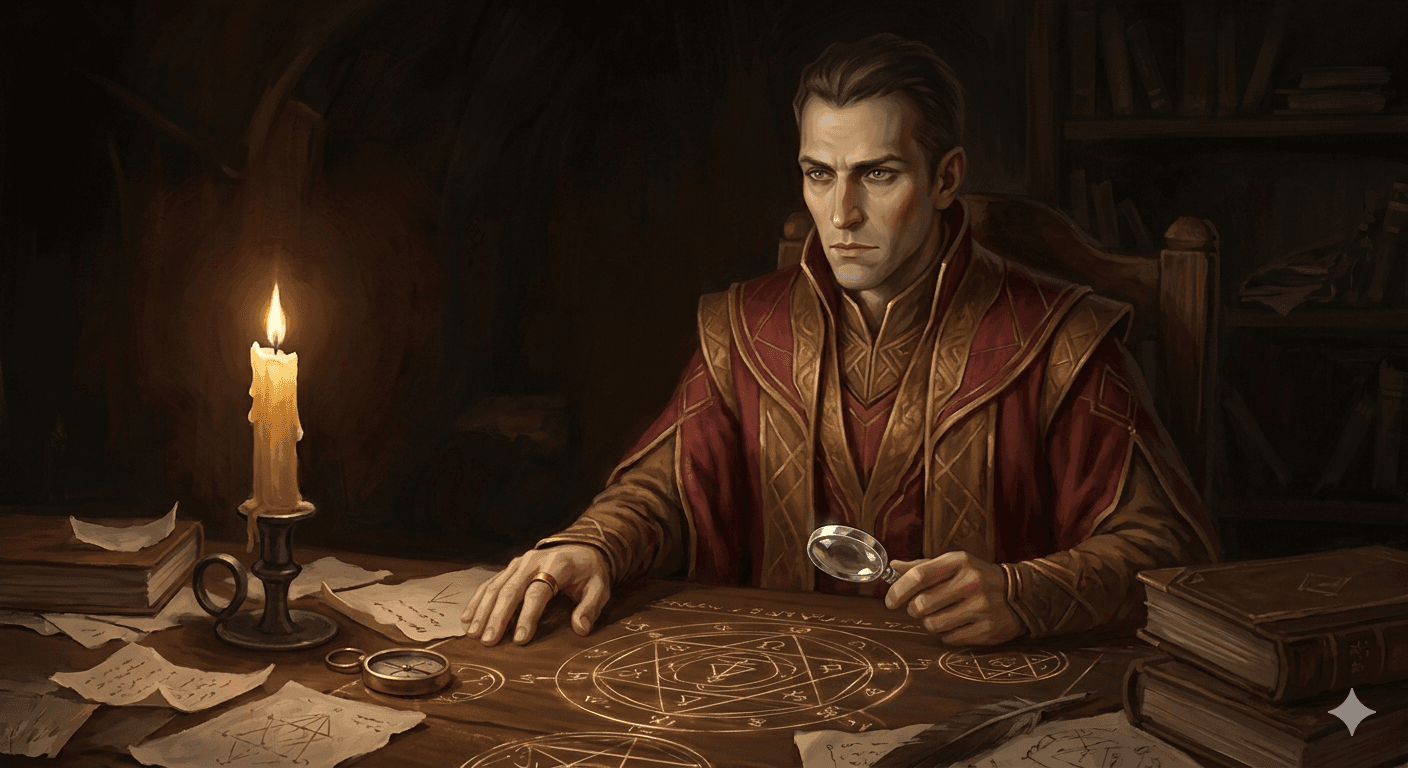
"He was the most brilliant mind the Empire ever produced. The Empire would have been safer if it had produced a mediocre one." — Empress Sylara Voss, private correspondence
Valdris (known posthumously as the Architect, or in The Driftborn tradition, the Breaker) was the Imperial Archmage of The Irenian Empire and the creator of The Heartstone. He is directly responsible for The Sundering. His fate after the Night of the Sundering is unknown — and that unknown is one of the most dangerous open questions in Aethermoor.
Life Before the Sundering
Valdris was born to a minor noble family in the northern provinces, where magical talent was rarer and regarded with more suspicion than in the capital. He was identified early as exceptional, sent to Vel Ira at age nine, and had earned his third master's distinction by fourteen. He was, by all accounts, driven by a conviction that The Weave was not a mystery to be respected but an engineering problem to be solved.
He rose to Imperial Archmage at thirty-two — the youngest in imperial history. His appointment was controversial; he had already published several papers arguing that the Veilwardens' cautious approach to the Weave was not wisdom but cowardice.
For thirty years he worked on The Heartstone with the Empire's full resources behind him. His correspondence during this period is almost entirely technical. The personal letters stop around Year 7 of the project. Those who knew him reported a gradual change: the driven young mage became something quieter, more intense, and increasingly difficult to read.
The Night of the Sundering
What Valdris actually intended that night is the central unanswerable question of Aethermoor's history. Three dominant theories:
The Ambition Theory — Valdris knew the Heartstone would do exactly what it did. His goal was not unlimited power for the Empire but unlimited power for himself — specifically, absorption into The Weave as something like a god. The Veilwardens hold this view and cite the fact that Valdris's body was never found.
The Miscalculation Theory — Valdris believed his models were correct and was simply wrong. The most catastrophically consequential engineering error in human history. The Iron Compact finds this view politically useful, as it places blame on individual hubris rather than systemic exploitation.
The Sacrifice Theory — held by a small but growing cult called the Architects of the New Sky — Valdris knew the Empire was unsustainable and chose to end it deliberately, clearing the ground for something better. In this telling he is a grim savior rather than a villain.
Current Status: Unknown
No body was found. No final statement was given. The Breach — the scar in the sky above where Vel Ira stood — pulses with a magical signature that The Veilwardens scholars have tentatively matched to Valdris's recorded personal resonance.
Possibilities debated in academic and arcane circles:
- He died in the explosion
- He was absorbed into The Weave and persists there in some altered form
- He ascended to something beyond conventional mortality
- He survived and has been in hiding for five centuries for reasons unknown
The Ashen Court has standing orders to capture, not kill, anyone who can be positively identified as Valdris or a vessel for his consciousness. They will not say why.
The Veilwardens have a sealed vault — the Valdris Protocols — containing contingency plans for each of the four scenarios above.
Cultural Afterlife
Valdris is the most famous name in Aethermoor and the most argued-over. He appears in:
- Cautionary tales for children in The Iron Compact cities: the mage who reached too high
- Sacred texts of the Architects of the New Sky: the necessary destroyer, the pruning storm
- The Veilwardens' Oath: every new Warden swears never to repeat "the sin of the Architect"
- Driftborn storm-songs: "The Breaker's hands are in every wind" — a line of genuine ambiguity, meaning either that his destruction is still felt, or that he is still present
Physical Description (From Imperial Records)
Tall, lean, grey-eyed. Clean-shaven, which was unusual for the era. Reportedly had a habit of sketching geometric diagrams on any available surface while thinking. Wore no jewellery except a single copper ring, which some scholars have theorized was an early prototype of The Heartstone's focusing mechanism.
Related Topics
- The Sundering — the event he caused
- The Heartstone — the device he built
- The Irenian Empire — the civilization he destroyed
- Empress Sylara Voss — who authorized his work and never stopped regretting it
- The Breach — the scar that may still carry his signature
- The Weave — what he tried to master, and what he tore
