The Shattered Pantheon
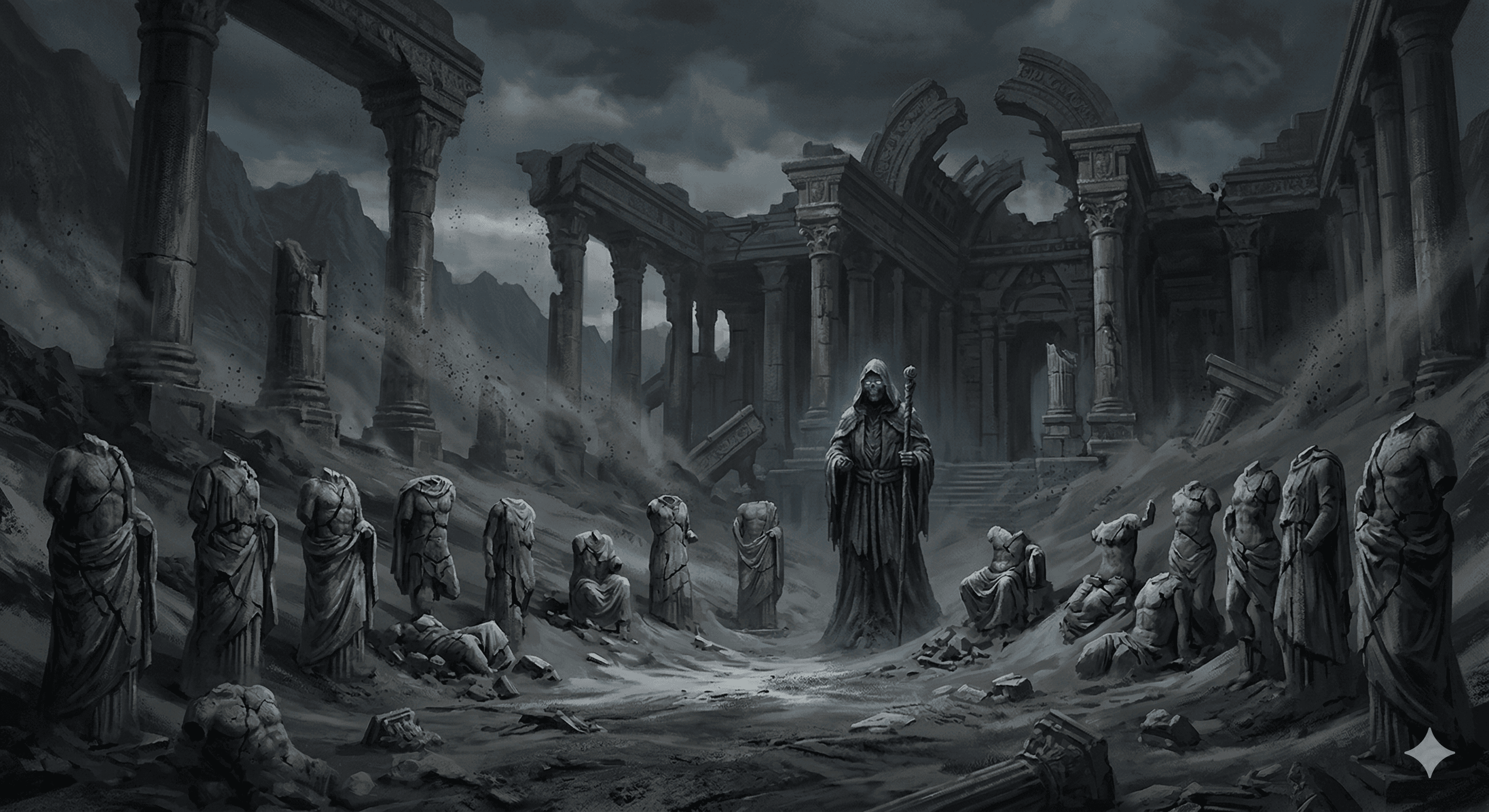
The Shattered Pantheon is the collective term for the gods of the old The Irenian Empire — a polytheistic tradition of seventeen major deities who were actively worshipped, propitiated, and credited with answering prayers before The Sundering. Since the Sundering, divine activity has fallen to near-silence. Temples still stand. Prayers are still offered. Whether anything answers them is debated.
What filled the silence is more varied, and more interesting.
The Old Gods
The Irenian pantheon was organized around a principle of domain correspondence: each god governed a specific aspect of existence, and their worship was essentially transactional. You prayed to the right god for the right thing. The system worked, in the sense that divine magic clearly functioned in the pre-Sundering era — clerics received spells, oracles received visions, and the gods were understood to be actively present in the world.
Key figures:
Vael, the Sky-Father — god of sky, wind, and high places. In pre-Sundering art, depicted as an elderly man seated on a mountain-peak above the clouds. Currently the most-claimed deity by sky-city populations — though the claim is more cultural than devotional for most.
Orra, the Tender — goddess of growing things, cycles, and the surface earth. Essentially irrelevant in the sky-city context — her domain is The Deadlands now. Still worshipped by those with hope for the surface.
Serath, the Keeper — god of memory, records, and the preservation of knowledge. Patron deity of The Sunken Archive and most libraries. Veilwardens maintain a small Serath chapel at the Collegium. His silence is taken particularly personally by scholars.
Vorn, the Unmade — god of death, endings, and transformation. Never had temples — only shrines. The most actively invoked deity in the post-Sundering world; the Sundering killed a lot of people, and someone has to handle the afterlife. Some theologians argue that Vorn is the only old god who might have been empowered by the Sundering rather than diminished by it.
Why Are the Gods Silent?
The central theological question of the post-Sundering world. Five major theories:
The Death Theory — the gods were not transcendent beings but powerful entities whose existence was tied to The Weave. When the Weave was damaged at the Sundering, some or all of the gods were destroyed or severely diminished. Divine magic still functions (barely, in some domains) because the Weave retains some memory of the old patterns, not because the gods actively channel it.
The Departure Theory — the gods saw the Sundering coming and withdrew to a realm beyond the Weave's reach. They are intact but inaccessible. When the Weave is repaired, contact will be restored. (The Veilwardens find this theory convenient and are possibly too attached to it.)
The Sleeping Theory — the gods were not killed or withdrawn but stunned — the magical shock of the Sundering induced a kind of hibernation. The Driftborn's cosmology is closest to this view; they believe the gods sleep in The Deadlands below, and that what stirs in the ruins is the edge of their dreaming.
The Culpability Theory — the gods are silent because they are guilty. They permitted the Sundering. They could have intervened and didn't. Divine silence is not absence but shame. This theory is popular with the angrily devout and unpopular with formal clergy.
The Valdris Theory — Valdris the Architect didn't just tear The Weave; he tore into the divine layer. The Heartstone didn't just tap the Weave — it ruptured something above the Weave, in whatever realm the gods inhabit. The gods are silent because they are dealing with the equivalent of what happened to the continent, but in their world. This is a minority view with a small but passionate following.
What Replaced the Silence
Where institutional religion maintained old forms, folk religion diversified significantly.
The Sky Cults — reverence for the sky itself, the clouds, the weather, and the specific magical atmosphere of The Skyward Cities. Not organized; hundreds of local variants. Most The Driftborn practice is in this category, without calling it religion.
The Ember Faith — a religion centered on the few fires that survived on the surface of The Deadlands — notably the geothermal vents and volcanic features of the Riftlands. Their central belief is that the old world is not dead but still burning, and that fire is the form the gods took when their temples fell. Small but coherent. The Ember Faith is the only organization that maintains active presence in the Deadlands.
The Architects of the New Sky — a cult built around Valdris the Architect as a divine or semi-divine figure. He destroyed the world in order to rebuild it; the floating islands are not a catastrophe but a new creation. Currently small, mostly urban, and regarded with alarm by both The Veilwardens and The Iron Compact. Growing.
The Restored Church — the formal clergy of the old Irenian pantheon, maintained in something approaching its original institutional form by The Ashen Court. Full ritual, full hierarchy, services conducted in High Irenian. Most sky-city residents regard them as museum-quality. The Ashen Court regards them as politically essential.
Divine Magic, Currently
Divine magic — spells granted by gods to their clerics — still functions. Sort of.
The most common experience of modern divine magic is: inconsistent. Clerics receive spells, but not always the ones they pray for. Sometimes more, sometimes less. The threshold between a prayer "reaching" something and a prayer vanishing into silence is unclear and unpredictable.
Vorn, the Unmade has the most consistent divine magic return rate, which nobody finds comforting.
Orra, the Tender's clerics get spells most reliably when working near the Deadlands surface — another uncomfortable data point.
Vael, the Sky-Father's clerics get spells in proportion to altitude, more or less. High up: fairly reliable. In Compact cities: unreliable. In Breach zone: nothing.
Related Topics
- The Sundering — the theological fracture event
- The Weave — its relationship to divine power
- The Deadlands — where the Sleeping Theory locates the gods
- The Driftborn — who have the most developed post-Sundering cosmology
- The Ashen Court — who maintain the old formal religion
- Valdris the Architect — who is himself being deified in some traditions
