The Iron Compact
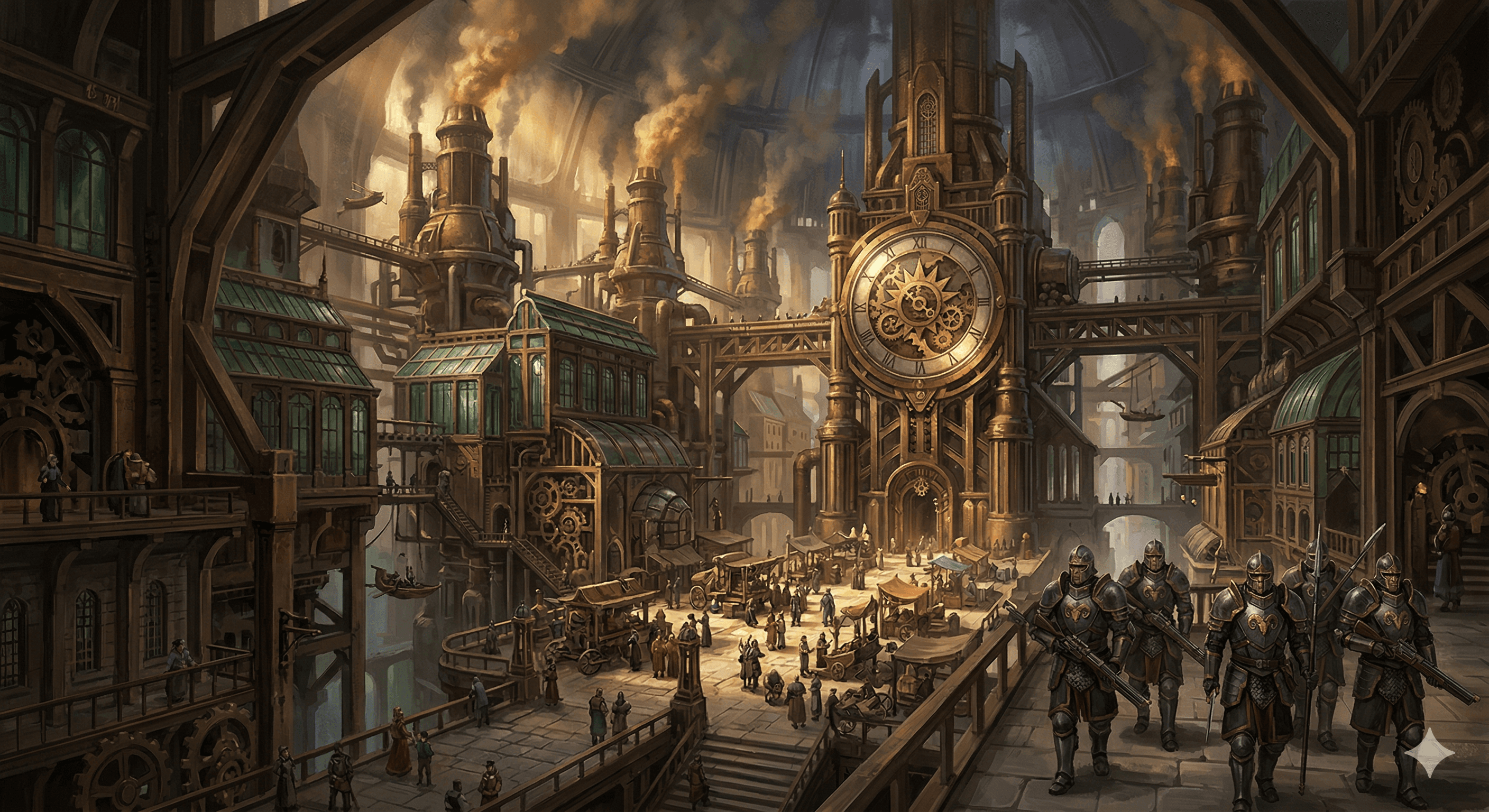
"We do not rule. We facilitate. Everything that works, works because we made it possible." — Iron Compact Charter Preamble, Year 88 of the Floating Age
The Iron Compact is the dominant political and economic power in The Skyward Cities, controlling the largest island cluster, most of the major trade routes, and the infrastructure that keeps sky-island civilization functioning. It presents itself as a pragmatic governance compact between the major islands' merchant houses. It functions as an empire that has learned to avoid the word.
Structure
The Iron Compact is technically a confederation of forty-seven Charter Houses — merchant families and trading guilds that collectively own the ships, bridges, water-systems, and aetheric engines of the western island cluster. Each Charter House holds seats in the Compact Council, votes weighted by assessed economic contribution.
In practice, five Houses control approximately eighty percent of the Council's effective votes. In practice within that practice, the House of Venmoor has controlled three of those five for the last sixty years through a combination of strategic marriage, debt, and well-documented willingness to make problems disappear.
The current Chair of the Compact Council is Chancellor Erris Venmoor, age sixty-two, in her fourth consecutive term. She is the most powerful individual in Aethermoor by most assessments.
What They Control
Infrastructure: The sky-bridges connecting Vel Mora and its cluster; the major cloud-harvest systems; the anchor-rings that allow sky-ships to dock safely.
Trade: Approximately seventy percent of inter-island food trade; the major manufactured goods networks (glass, metalwork, refined aetheric components); the licensing system for commercial sky-ship routes.
Security: The Ironwatch — a professional military-police force that patrols Compact islands, enforces trade law, and does whatever Chancellor Venmoor needs done. The Ironwatch is larger than some nations' armies.
Information: The Compact operates the only continent-spanning message relay system — signal towers on islands relay coded messages across the cluster. They have access to most of what passes through it.
Official Positions
On magic: The Compact regards The Weave primarily as a resource — the aetheric engines powering Vel Mora's anchoring systems and the Compact's largest sky-ships are built on Weave-tapping technology. The Veilwardens concerns about Weave degradation are characterized as exaggeration or self-interested fearmongering.
On the Deadlands: The surface is officially dead and legally irrelevant. Compact law does not recognize surface land rights. Any discovery made on the surface is legally "salvage" — a category that conveniently assigns discovery rights to the Compact-licensed salvage operators.
On the Heartstone shards: Officially, the Compact neither possesses nor pursues Heartstone shards. Unofficially, The Veilwardens have documented at least seven shards that passed through Compact territory and were not reported.
On the Ashen Court: A criminal organization engaged in fraud and harassment of legitimate Compact governance. Compact-controlled courts have standing warrants for several known Court members.
The Compact's Genuine Achievements
It would be a mistake — and The Veilwardens are sometimes guilty of making it — to see the Iron Compact as purely predatory.
The Compact built the sky-bridge network that allowed The Skyward Cities to develop as an interconnected civilization rather than a collection of isolated island-fortresses. It standardized currency, contract law, and trade weights across the cluster. Its cloud-harvest engineering genuinely feeds millions of people who would otherwise be dead. The aetheric engines it developed are, as yet, not demonstrably causing the Weave degradation the Veilwardens blame them for.
The problem is not that everything the Compact built is bad. The problem — as The Veilwardens and The Driftborn both argue — is that the Compact built everything on purpose so that everything good in sky-island life flows through it, making any challenge to its power a challenge to survival itself.
Internal Tensions
The Compact is not monolithic. Current fault lines:
The Venmoor faction (dominant): consolidate and control; manage the Weave question with public relations, not policy.
The Reform faction (minority, growing): genuine alarm about Weave degradation; they want research access and real numbers, even if the numbers are bad. Currently associated with House Kellast, the second-largest Charter House.
The Expansion faction: argues the Compact should pursue the Deadlands more aggressively — particularly The Sunken Archive and any Heartstone shards — to maintain dominance before other factions get there first.
These factions fight through Council procedures, trade maneuvering, and the occasional well-staged maritime accident.
Relationship with Other Factions
| Faction | Relationship |
|---|---|
| The Veilwardens | Cold war; mutual surveillance and regular public disputes over Weave policy |
| The Driftborn | Complicated dependency; Compact needs their pilots, resents their independence |
| The Ashen Court | Official enemies; unofficial back-channels that both sides deny |
Related Topics
- The Skyward Cities — the world they govern
- Chancellor Erris Venmoor — the current power behind the throne
- The Veilwardens — their main institutional antagonist
- The Driftborn — essential partners they can't fully control
- The Ashen Court — the dynastic claim that challenges their legitimacy
- The Weave — the magic they're exploiting
- The Heartstone — the shards they officially don't want
