The Deadlands
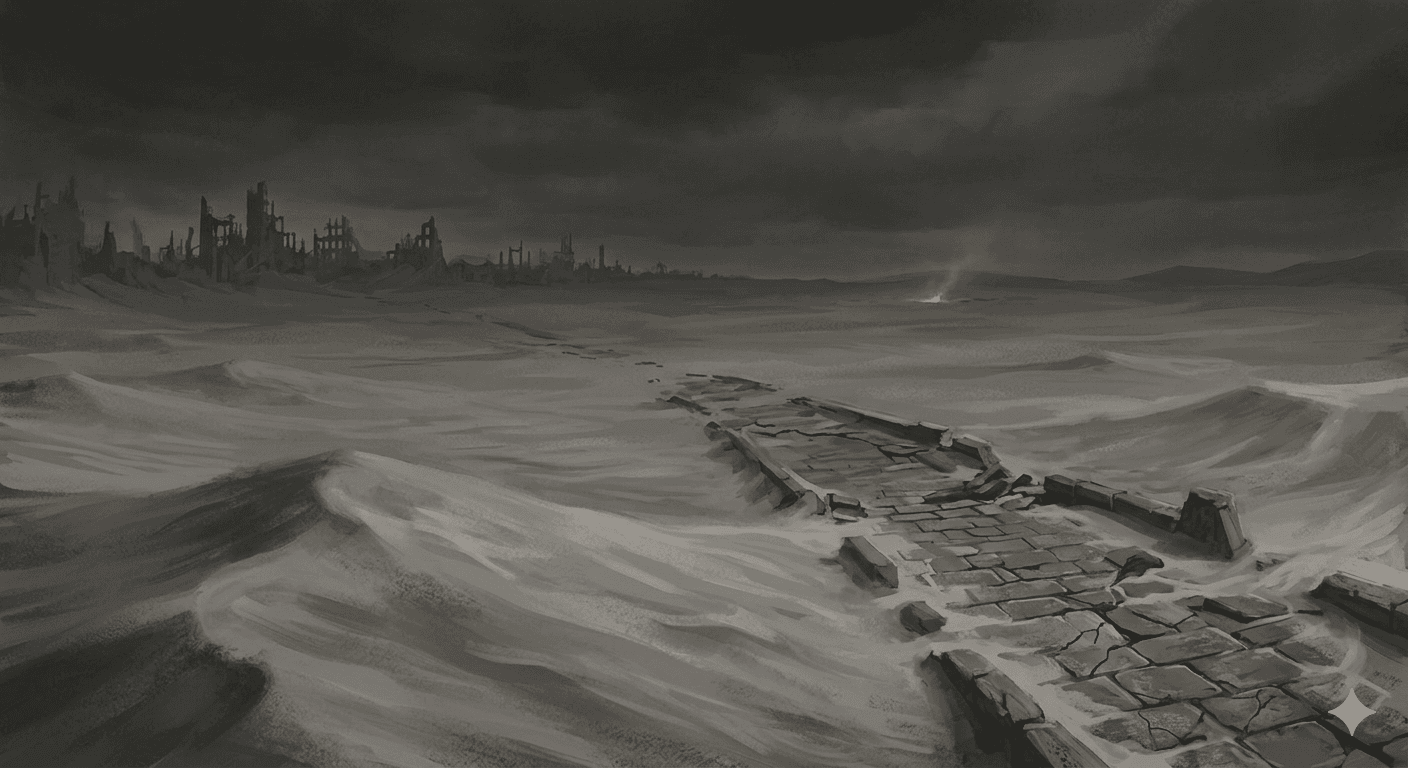
"There are people down there. We don't talk about that." — Overheard at a Driftborn Sky Moot
The Deadlands is the name for the surface world beneath The Skyward Cities — the ruined, ash-choked remnant of the old continent of Irenia that did not rise during The Sundering. For five centuries it has been considered uninhabitable: toxic, magically unstable, and permanently shrouded in the cloud layer that separates the surface from the floating islands above.
Most people in Aethermoor have never seen it. Most prefer not to think about it.
Conditions on the Surface
The Deadlands are not uniformly one thing. The general picture is catastrophic, but it is a varied catastrophe.
The Ashfields — the majority of the surface — are plains of grey-white volcanic ash deposited during the years immediately following the Sundering. Wind pushes it into dunes and ridges. Nothing grows in the deepest ashfields; the ash is metres deep and still shifts in massive silently rolling storms called ashfalls.
The Riftlands — regions where the Sundering cracked the surface open, releasing geothermal energy and wild magic simultaneously. These are the most obviously hostile zones: geysers of scalding water and superheated magical energy, glassified earth, and Riftpockets so dense that the laws of magic become meaningless. They are also, notably, warm — and certain hardy organisms have colonized the margins.
The Old Roads — the remnants of Irenian road networks. The imperial road system was built with remarkable durability; sections still stand, cutting through the ash in straight lines toward destinations that no longer exist. Deadlands expeditioners use them as navigation references.
The Drowned Lowlands — regions where the surface subsided after the Sundering and filled with water. Some are simple shallow lakes of grey-green water. Others are the locations of sunken cities, including (scholars believe) portions of The Sunken Archive.
The Cloud Layer
A permanent dense cloud layer sits between the surface and the floating islands above — low enough to obscure the Deadlands from the sky-dwellers, high enough that surface-dwellers (if any exist) would see the islands only as occasional dark shapes moving against a bright grey ceiling.
The cloud layer is magically thickened. The Veilwardens theorize it is a side effect of the aetheric evaporation from the Deadlands surface — magic dissipating into the upper atmosphere where it condenses like water vapor. It is extremely difficult to navigate through, and dangerous — sky-ships that descend into it often experience magical instrument failure, crew disorientation, and structural stress.
The Iron Compact policy prohibits its ships from descending below the cloud ceiling. The official reason is safety. There are unofficial reasons.
The Question of Survivors
Five hundred years is a long time. The Sundering happened on the surface. Not everyone was in the path of the initial blast; not everyone could reach the rising islands. Some portion of the pre-Sundering population stayed on the ground.
The dominant assumption in The Skyward Cities is that everyone who remained on the surface died in the years following the Sundering. This assumption is convenient.
Evidence suggesting it may be wrong:
- The Driftborn cloud-runners who descend near the cloud ceiling sometimes report lights moving below — organized, not volcanic
- A series of signals using an adapted Irenian flag-code was recorded by a Veilwarden weather station in Year 312. The source was below the cloud layer. The records were sealed.
- The Ashen Court reportedly has documents suggesting Empress Sylara Voss maintained secret correspondence with surface survivors for decades after the Sundering
None of this has been officially acknowledged. The Iron Compact has significant motivation to prevent surface habitation from being recognized as legitimate — it would complicate the legal basis of their island property claims, which rest on the doctrine that the old land-rights died with the surface.
Deadlands Expeditions
Despite the dangers, people descend. The Deadlands are full of old-world artifacts, Heartstone shards, and records of the pre-Sundering world that have no equivalent above the clouds.
Most expeditions are organized by:
- The Veilwardens, searching for Weave-stabilization research and The Heartstone shards
- Independent treasure-hunters, searching for Heartstone shards and marketable artifacts
- The Ashen Court, searching for evidence supporting their imperial legitimacy claims
- Smugglers, using the Deadlands as a route that The Iron Compact patrol ships won't follow
The Iron Compact does not organize surface expeditions officially. There are persistent rumors about what they do unofficially.
Expeditionary mortality is high. Those who return rarely go back. Those who go back rarely return.
The Deadlands in Religion and Myth
The surface world occupies a specific place in post-Sundering spirituality. In the dominant sky-city tradition, descending to the Deadlands is equivalent to descending to the underworld — entering the realm of the dead.
The Shattered Pantheon's traditions assign various surface regions to various dead or diminished deities. The Driftborn have the most elaborate cosmology of the surface: in their tradition, the Deadlands are not a dead place but a sleeping one, and what sleeps in it will eventually wake.
Whether this is poetic or predictive is a matter of ongoing Driftborn theological debate.
Related Topics
- The Sundering — what created this
- The Skyward Cities — what exists above it
- The Sunken Archive — one of the most significant surviving sites on the surface
- The Breach — the scar above the original blast site
- The Heartstone — its shards are still scattered across the surface
- The Shattered Pantheon — how the surface figures in post-Sundering religion
